
Lesson 1: Symmetrical Properties of Circles
Video Lesson:
Competency:
At the end of this lesson, you will be able to:
- Discover the symmetrical properties of circles.
- Use the symmetrical properties of circles to solve related problems.
- Explain angle properties of circles in their own words.
- Apply angle properties of circles to solve related problems.
Key terms:
- Circle
- Centre
- Line of symmetry
- Chord
Brainstorming Questions
1. What is a circle?
2. Draw a circle and indicate its center, radius and diameter.
3. What is line of symmetry?
4. How many lines of symmetry does an equilateral triangle have?
Answer
A circle is set of points in a plane each of which is equidistant from a fixed point in the plane. The fixed point is called the center of the circle and the constant distance is called its radius.
- 𝑂 is the centre, 𝑅 is the radius and 𝐷 is the diameter.
- The line of symmetry can be defined as the axis or imaginary line that passes. Through the centre of the shape or object and divides it into identical halves.
- Equilateral triangle has three lines of symmetry.
1.1. Introduction to Circles
Definition
A circle is the locus of points (set of points) in a plane each of which is equidistant from a fixed point in the plane.
- The fixed point is called the centre of the circle and
- The constant distance is called its radius.
- Thus, the circle is defined by its centre O and radius r.
- Recall that area of a circle, 𝐴 = 𝜋𝑟2 and perimeter of the circle, 𝑃 = 2𝜋𝑟.
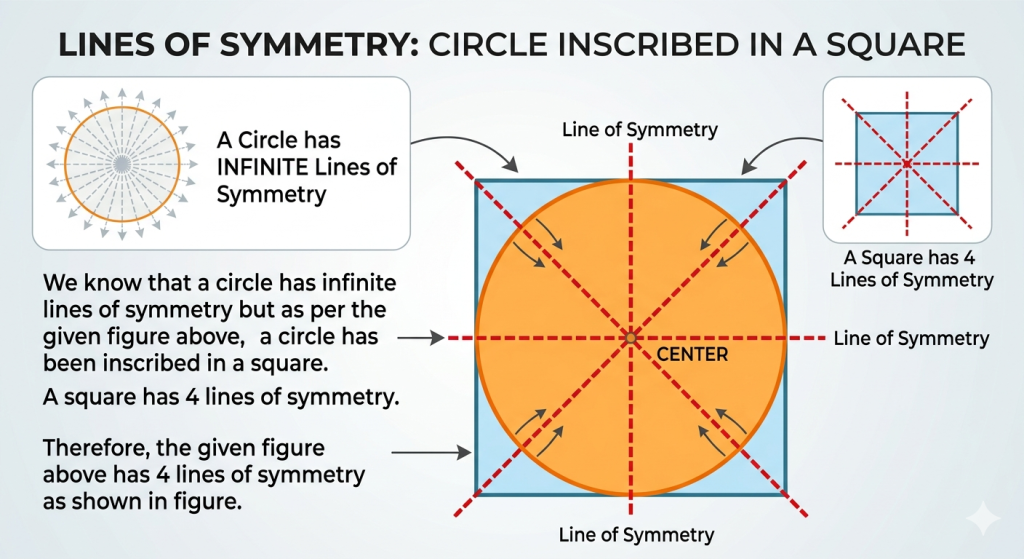
- Any diameter of a circle can be considered as a line of symmetry for the circle.
- An object can have zero lines of symmetry or it can have infinite lines of symmetry.
Example 1
Theorem:
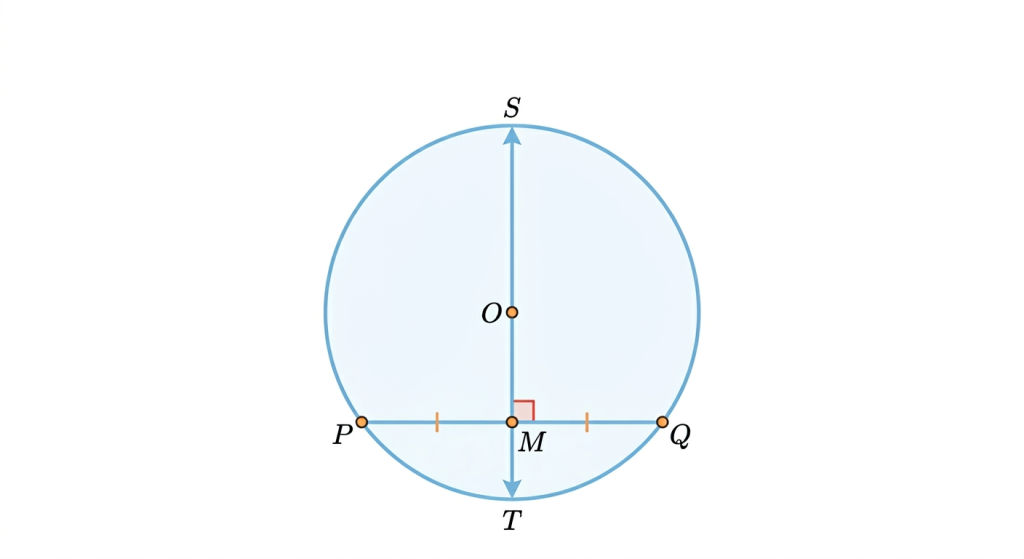
The line segment joining the center of a circle to the midpoint of a chord is perpendicular to the chord.
Proof:
Given A circle with center 𝑂 and a chord (PQ) whose midpoint is 𝑀. We want to prove that ∠𝑂MP is a right angle. Draw the diameter (ST) through point M. Then, the circle is symmetric about (ST) and (PM) ≡ (QM) .
So, (ST) is perpendicular bisector of PQ and hence ∠𝑂MP is a right angle.
Example 2:
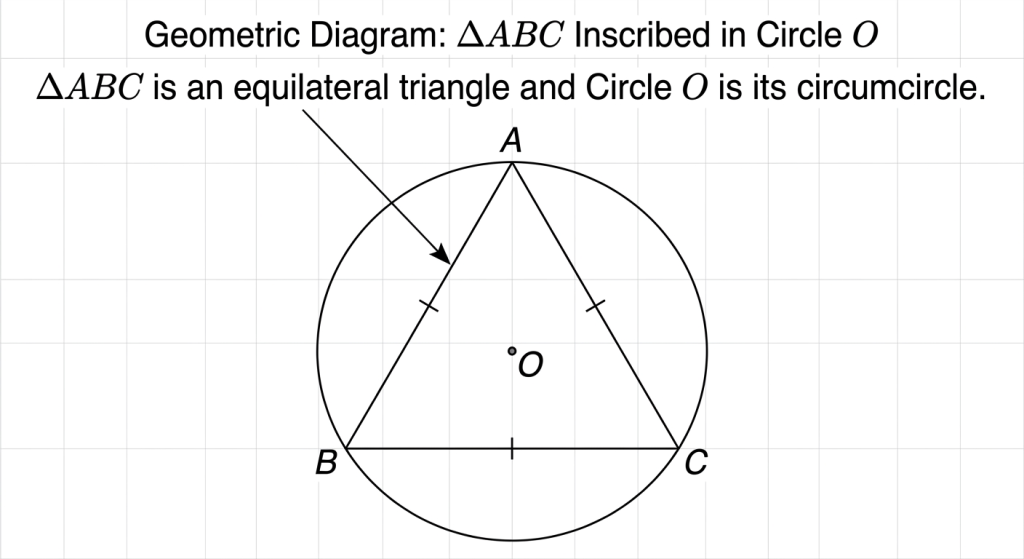
𝛥𝐴𝐵𝐶 is an equilateral triangle and circle O is its circumcircle. How many lines of symmetry does figure below have?
Solution:
An equilateral triangle has three lines of symmetry
Theorem:
The line segment drawn from the centre of a circle perpendicular to a chord bisects the chord.
Proof:
Given: A circle with centre 𝑂 and (ON) is drawn from centre 𝑂 perpendicular to the chord 𝐴𝐵 as shown in figure below.
We want to prove that (AN) ≡ (NB).
Join (OA) and (OB).
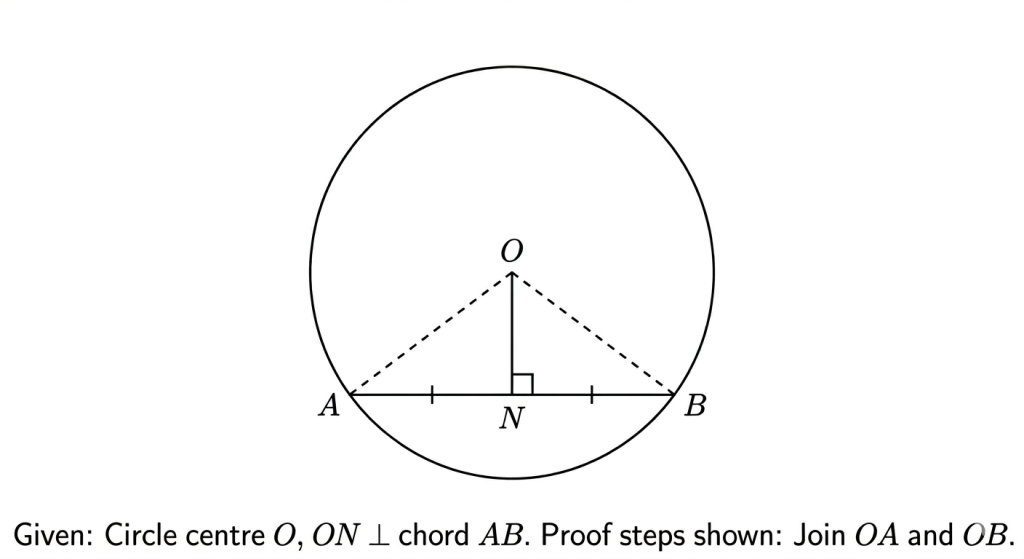
- (OA) ≡ (OB) …radii of circle
- m(∠𝐴𝑁𝑂) = 𝑚(∠𝐵𝑁𝑂) …both equal to 90°
- (ON) ≡ (ON) …common side
- ∆𝐴𝑂𝑁 ≡ ∆𝐵𝑂𝑁 …by RHS-criteria of congruency
- (AN) ≡ (BN) …by step 4
Theorem:
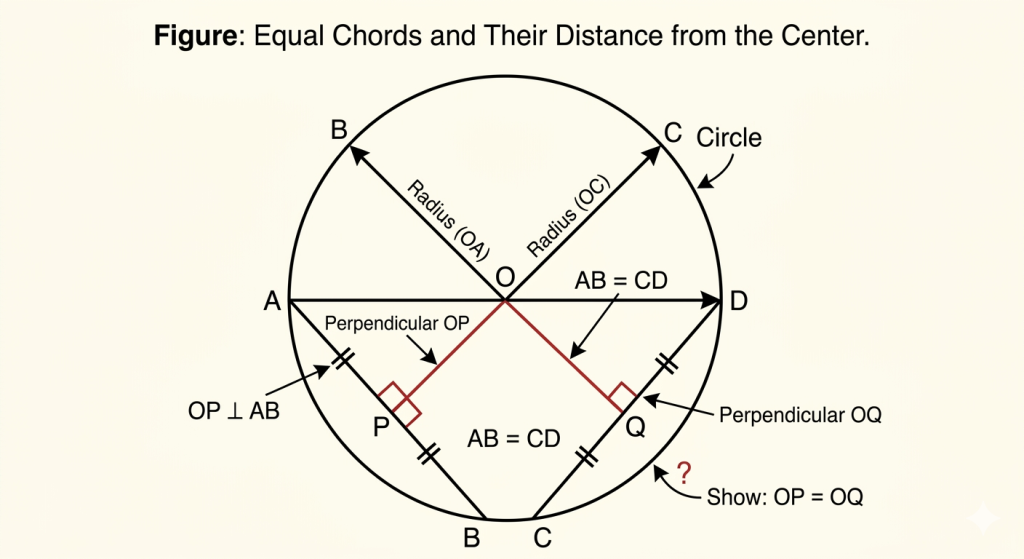
Equal chords of a circle are equidistant from the center of the circle.
Proof:
Given: Chords (AB) and (CD) are equal in length. Construction: Join points 𝐴 and 𝐶 with center 𝑂 and drop perpendiculars from 𝑂 to the chords (AB) and (CD) (see figure). We want to prove: (OP) ≡ (OQ).
Characteristics of Chord
Theorem:
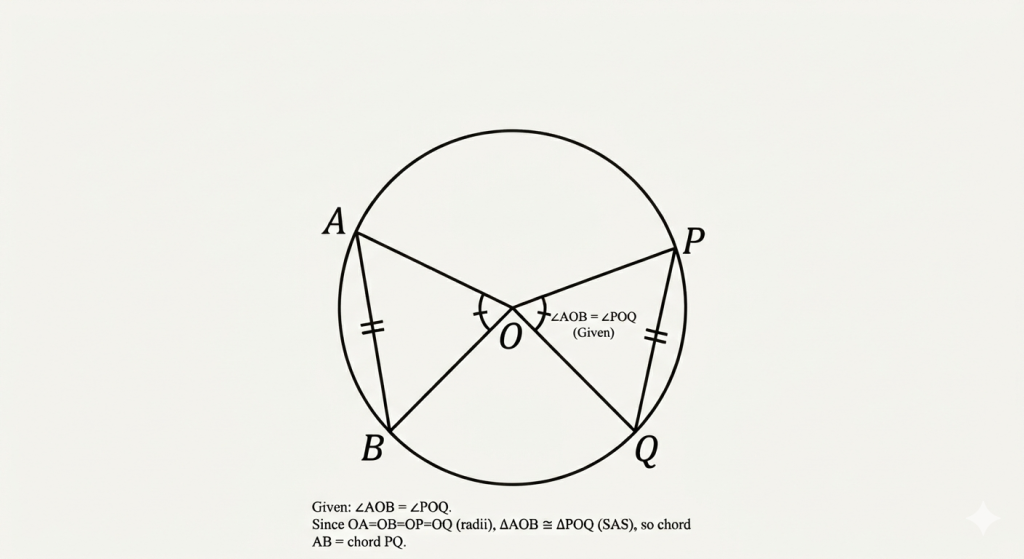
If the angles subtended by the chords of a circle are equal in measure, then the length of the chords are equal.
Proof:
From figure below, consider ∆AOB and ∆POQ.
Theorem:
Chords which are equal in length subtend equal angles at the Centre of the circle.
Proof:
From figure below, consider ∆AOB and ∆POQ. We want to prove ∠AOB ≡ ∠POQ.
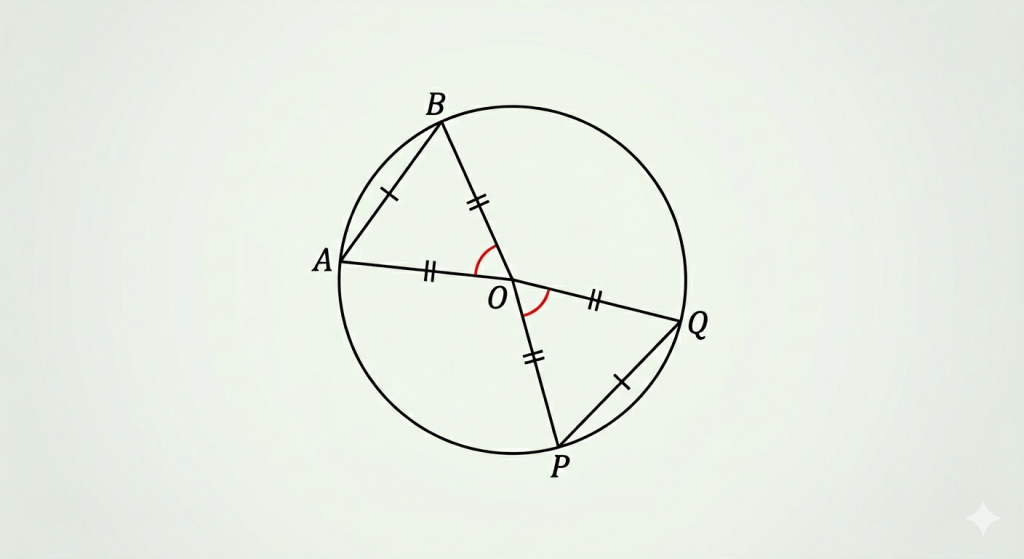
| Steps | Statement | Reason |
| 1 | AB ≡ PQ | Given |
| 2 | OA ≡ OB ≡ OP≡ OQ | Radii of the same circle |
| 3 | ∆𝐴𝑂𝐵 ≡ ∆𝑃𝑂𝑄 | SSS postulate of Congruence |
| 4 | m(∠AOB) = 𝑚(∠𝑃𝑂𝑄) | From step 3 |
Example 3
If the chord of a circle of radius 10 cm is 16 cm long. Find the distance of the chord from the centre.
Solution:
1.2 Angle Properties of Circles
1.2.1. Central Angles and Inscribed Angles
Activity
Define the following terms: chord, diameter, radius, tangent, secant, arc, major and minor arc.
Answer
- The chord of a circle can be defined as the line segment joining any two points on the circumference of the circle.
- The diameter is the longest chord in a circle.
- The distance from the centre point to any endpoint on the circle is called the radius of a circle.
- A tangent to a circle is a straight line which touches the circle at only one point.
- A straight line that intersects a circle at two points is called a secant line.
- An arc is a smooth curve joining two points. Consequently, on a circle, every pair of distinct points determines two arcs:
Two points lying on a circle actually define two arcs. The shorter is called the ‘minor arc‘ and the longer one is called the ‘major arc‘.
Remark:
- A major arc is an arc connecting two endpoints on a circle and its measure is greater than180°or π. (See the figure below). Arc ACB (is major arc).
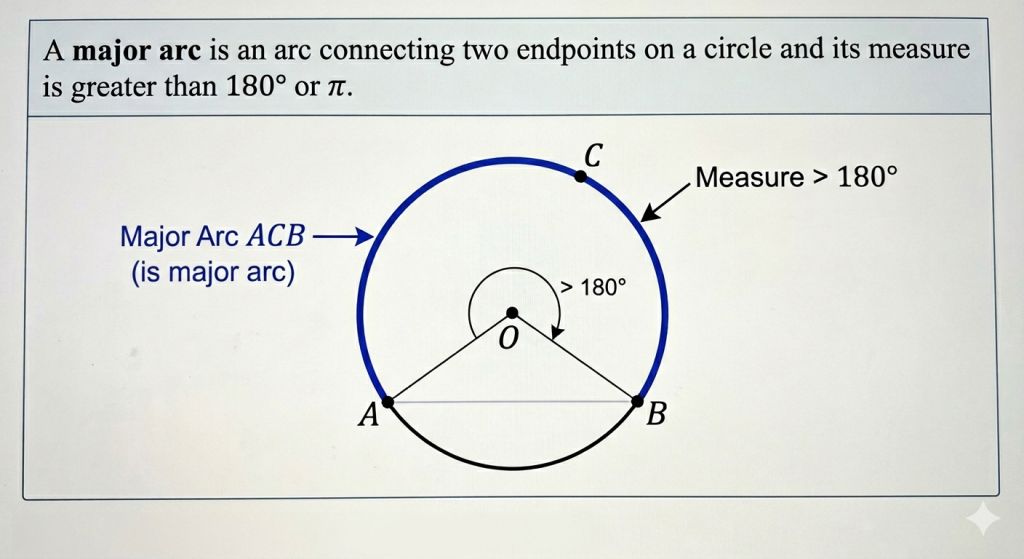
2. Minor arc is an arc connecting two endpoints on a circle and its measure is less than 180° or π. (See figure below) Arc ACB ( is minor arc. Usually denoted by two letters. So we call minor arc AC.
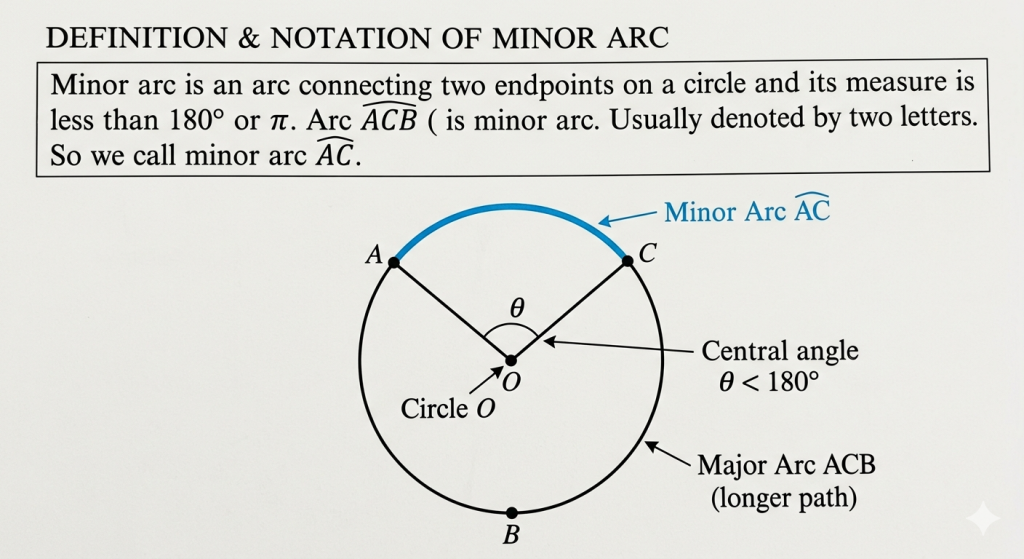
3. A major arc is usually referred to with three letters and a minor arc is usually referred to with only two letters.
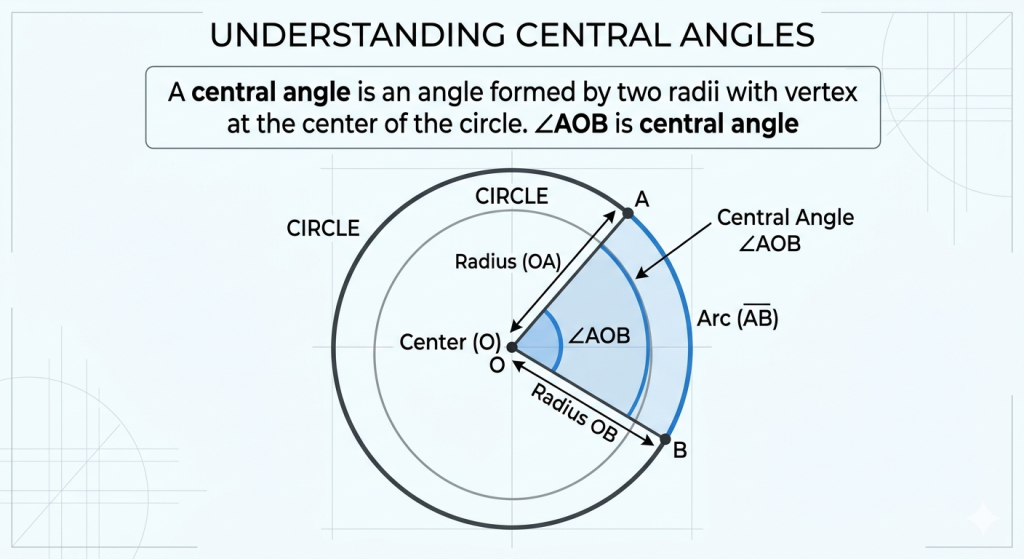
4. A central angle is an angle formed by two radii with vertex at the center of the circle. (See figure below) ∠AOB is central angle.
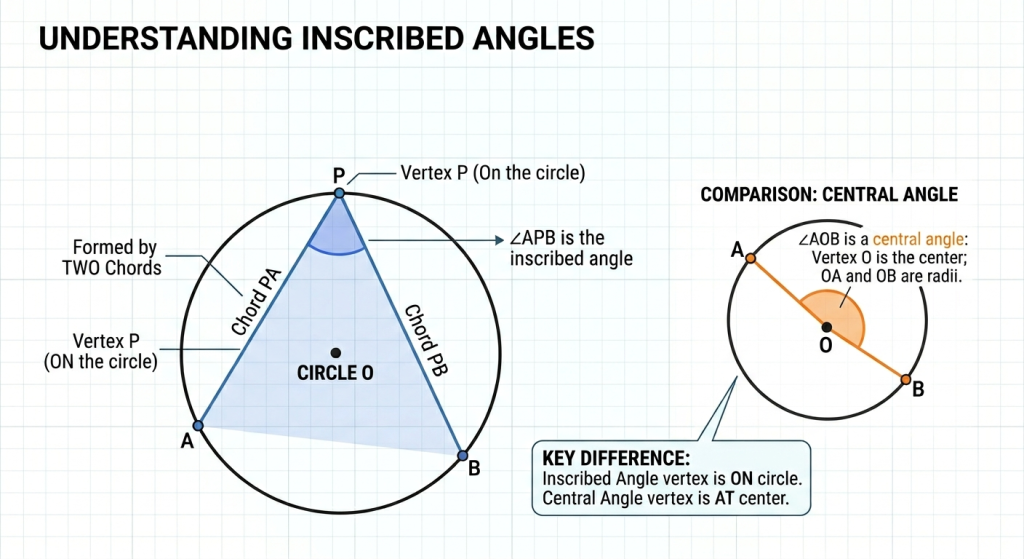
5. An inscribed angle is an angle with vertex on the circle formed by two intersecting chords. (See figure below) ∠APB is inscribed angle.
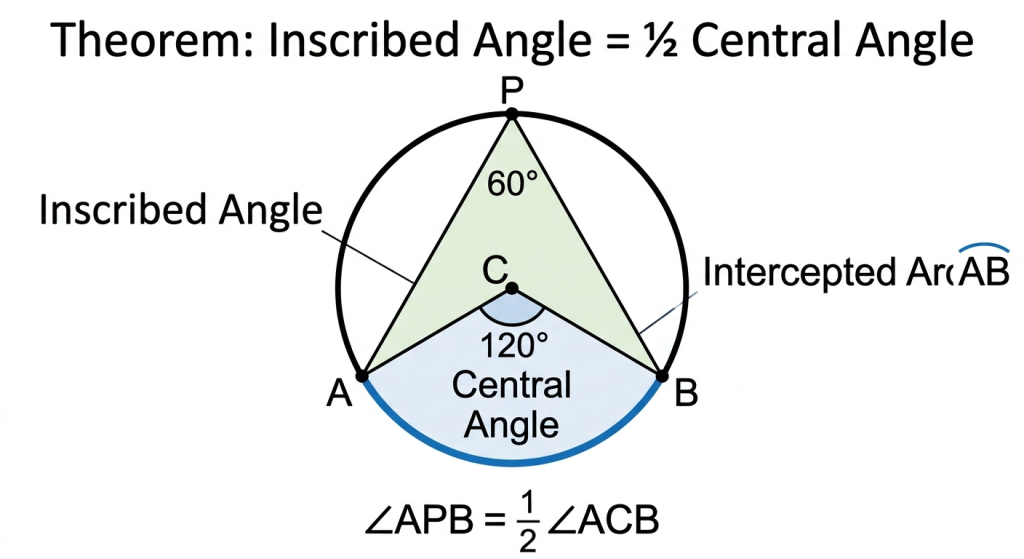
Theorem:
If an inscribed and a central angle intercept the same arc, then the measure of an inscribed angle is half of the measure of a central angle.
Example 4
In each of the following figures, O is the centre of the circle. Calculate the measure of the angles marked x.
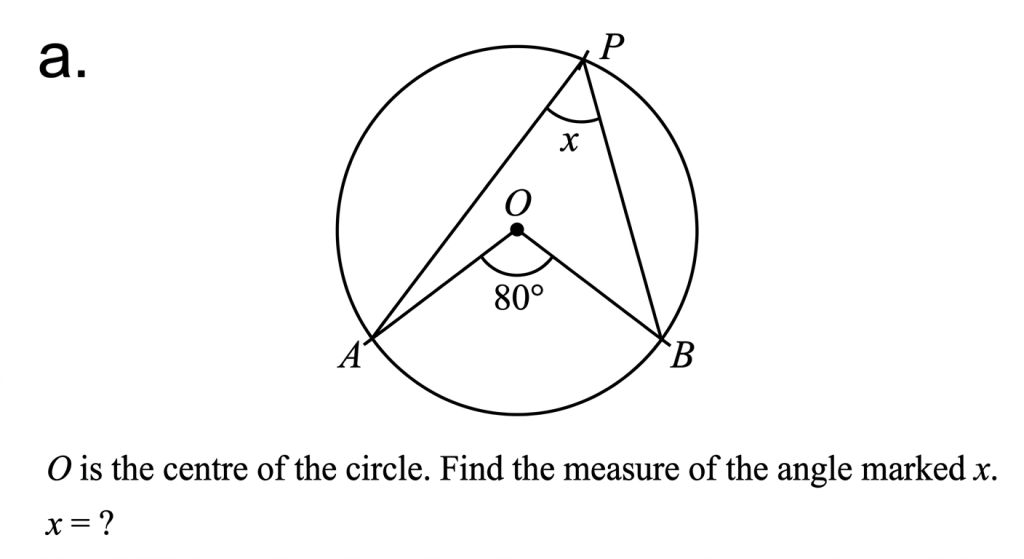
x = ½ (80°) = 40°
b.
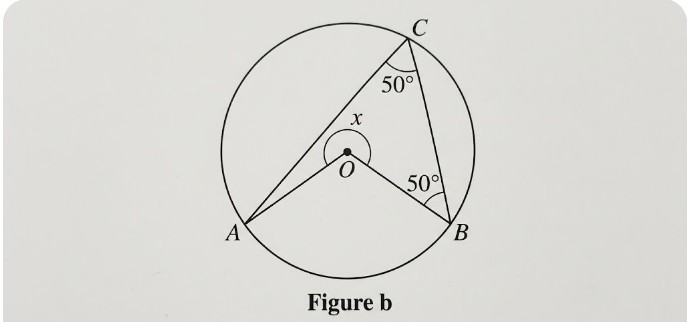
x +<AOB=360° and <AOB=2 × 50° = 100°.
Hence, x=360°-100°=260°.
1.2.2. Measure of Central Angles and Inscribed Angles
Theorem:
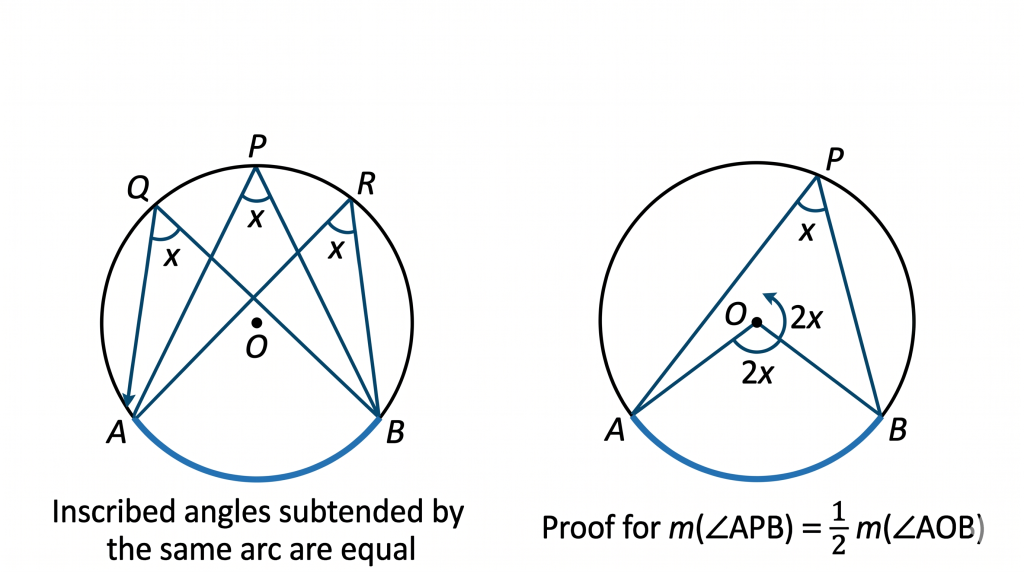
Inscribed angles subtended by the same arc have the same measure.
Proof:
In Figure below, m(∠𝐴P𝐵) = ½ m(∠𝐴O𝐵)
m(∠𝐴Q𝐵) = ½ m(∠𝐴O𝐵)
Therefore, m(∠𝐴P𝐵) = m(∠𝐴Q𝐵).
Example 5
Calculate the marked angle in the following figure:
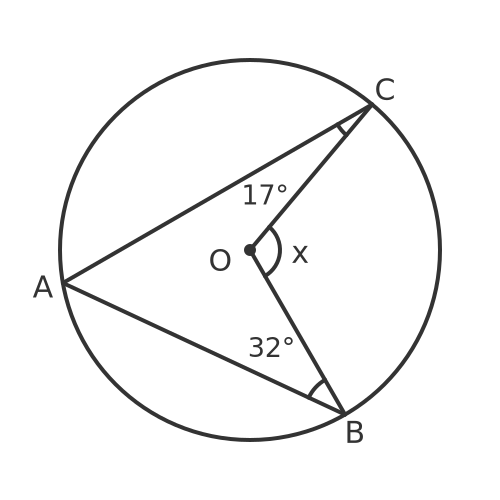
Solution:
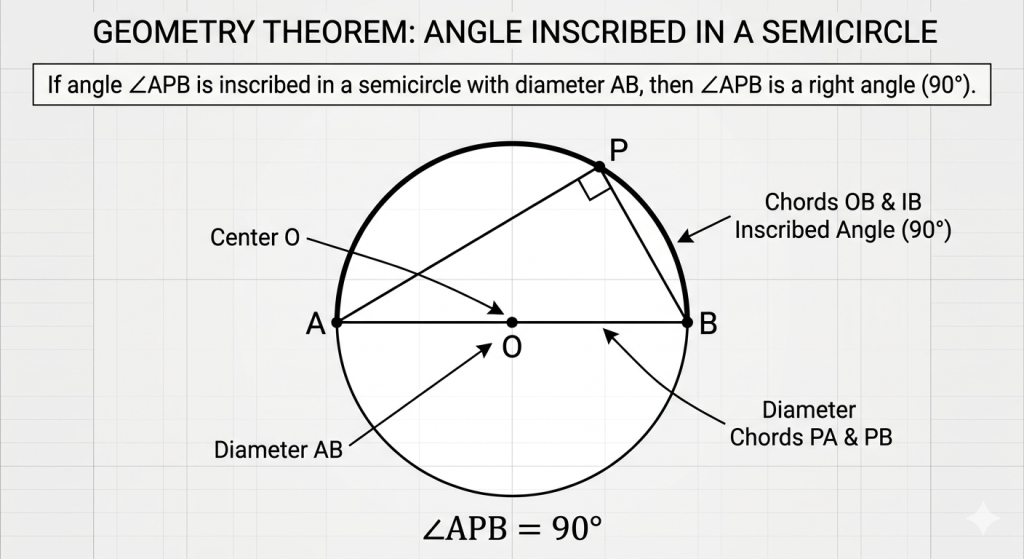
Theorem: Angle in a semicircle (Thales’ Theorem)
An angle inscribed in a semicircle is a right angle.
Example 6
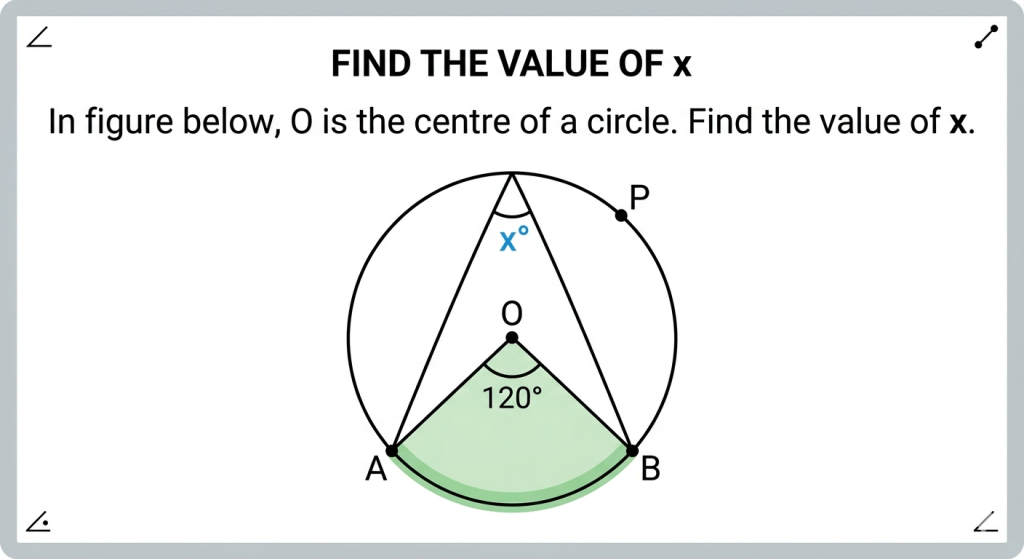
Solution:
1.2.3. Cyclic Quadrilateral
Definition:
A quadrilateral is said to be a cyclic quadrilateral if there is a circle passing through all its four vertices.
Theorem:
The sum of the measures of opposite angles in a cyclic quadrilateral is 180°.
Proof:
Given: A cyclic quadrilateral WXYZ is inscribed in a circle with centre 𝑂 as shown in figure below.
Construction: Join the vertices 𝑊 and 𝑌 with centre 𝑂.
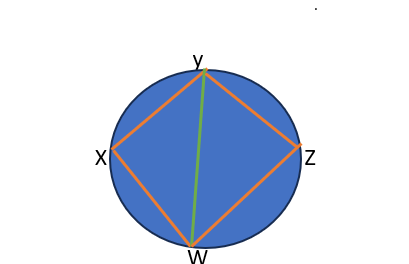
We want to show: m(∠WXY) + m(∠ WZY) = 180°. Consider arc WXY and arc WZY
- ∠WOY ≡ 2∠WZY (The angle subtended by same arc is half of the angle subtended at the center)
- Reflex angle WOY ≡ 2arcWXY (the angle subtended by same arc is half of the angle subtended at the center).
- m(∠WOY) + Reflex m(∠WOY) ≡ 360° (Using steps 1 and 2).
- 2m(∠WZY) + 2m(∠WXY) = 360° (Using steps 1 and 2).
- 2(m(∠WZY) + m(∠WXY)) = 360°(Why?).
- m(∠WZY) + m(∠WXY) = 180° (Why?)
Example 7
If the measures of all four angles of a cyclic quadrilateral are given as (4𝑦 + 2), (𝑦 + 20), (5𝑦 – 2), and 7𝑦 respectively, find the value of 𝑦.
Solution:
The sum of all four angles of a cyclic quadrilateral is 360°. So, to find the value of 𝑦, we need to equate the sum of the given four angles to 360°.
(4𝑦 + 2) + (𝑦 + 20) + (5𝑦 – 2) + 7𝑦 = 360°
17𝑦 + 20 = 360°
17𝑦 = 340°.
Therefore, 𝑦 = 20°.